
Christine
M. Janis
Professor
Ph.D., Harvard University
(requires Adobe®
Acrobat® Reader®)
My current research has two main focuses. Firstly in ongoing collaboration with colleagues who share my interest
in patterns of mammalian community change during past 20 million years or so, and how this reflects the cooling and
drying of environments in the northern latitudes during this time. In my role as senior editor for the two volumes
of "The Evolution of Tertiary Mammals of North America" (first volume published in 1998, second volume to be published
in 2007) I have amassed a large database of "who was where when" of North American mammals. John Damuth (University of
Santa Barbara) and I have several publications on how the community structure of large mammals changes over this time period
(see Janis, Damuth and Theodor 2000, 2002, 2004), and with the completion of the second volume of the mammals book we will
embark on comparing evolutionary patterns in large and small mammals. Both John and I interact with Mikael Fortelius
(University of Helsinki), who has amassed a similar database on Eurasian mammals from the same time period, and we shall
be comparing patterns of community evolution between continents.
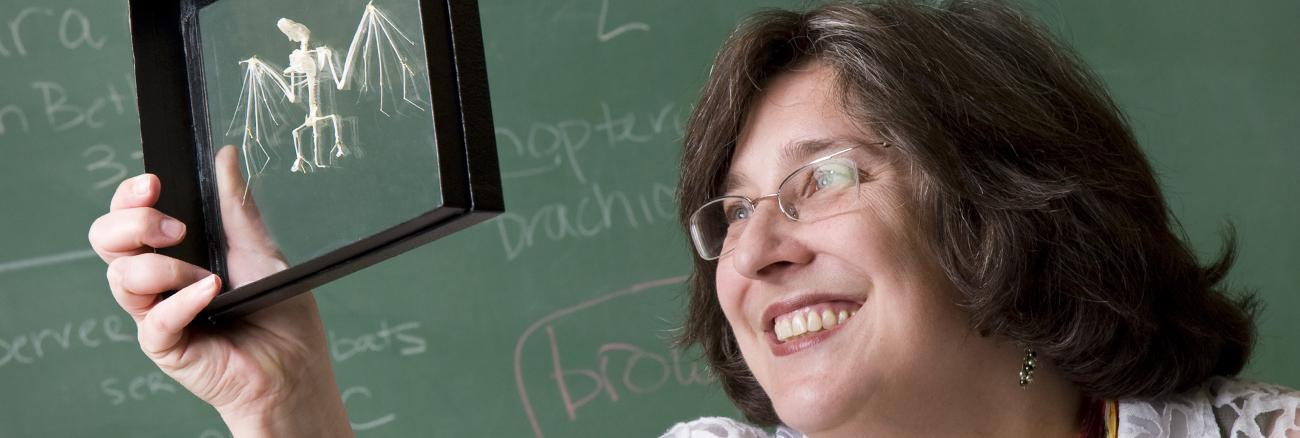
Another line of current research focuses more on the functional morphology of individual fossil lineages. My original research
into paleobiological problems of this nature involved the use of dental and skull remains to determine diet, but more recently
I have become interested in the postcranial skeleton and evolution of locomotion. Recent work in this area has involved
undergraduates working on honors theses, including a study of the evolution of the pacing gait in camels (see Janis,
Theodor and Boisvert, 2002) and the mode of locomotion in sthenurine kangaroos (extinct giant browsing forms). I plan
to continue the investigation into sthenurines: these animals are especially interesting (and challenging!) as preliminary
work shows that they were very unlike other kangaroos, and may have had a type of locomotion with no living analog. I also
plan to return to some work that had its inception a while ago (see Janis and Wilhelm 1993), on the reason why mammals
evolve cursorial (i.e., running) limb adaptations (my hypothesis is that it's really more related to energy conservation
at slow gaits rather than speed at fast gaits). Preliminary data on the evolution of horse legs supports this hypothesis,
and I will be collecting and analysing more data on this research project in the near future.
top |