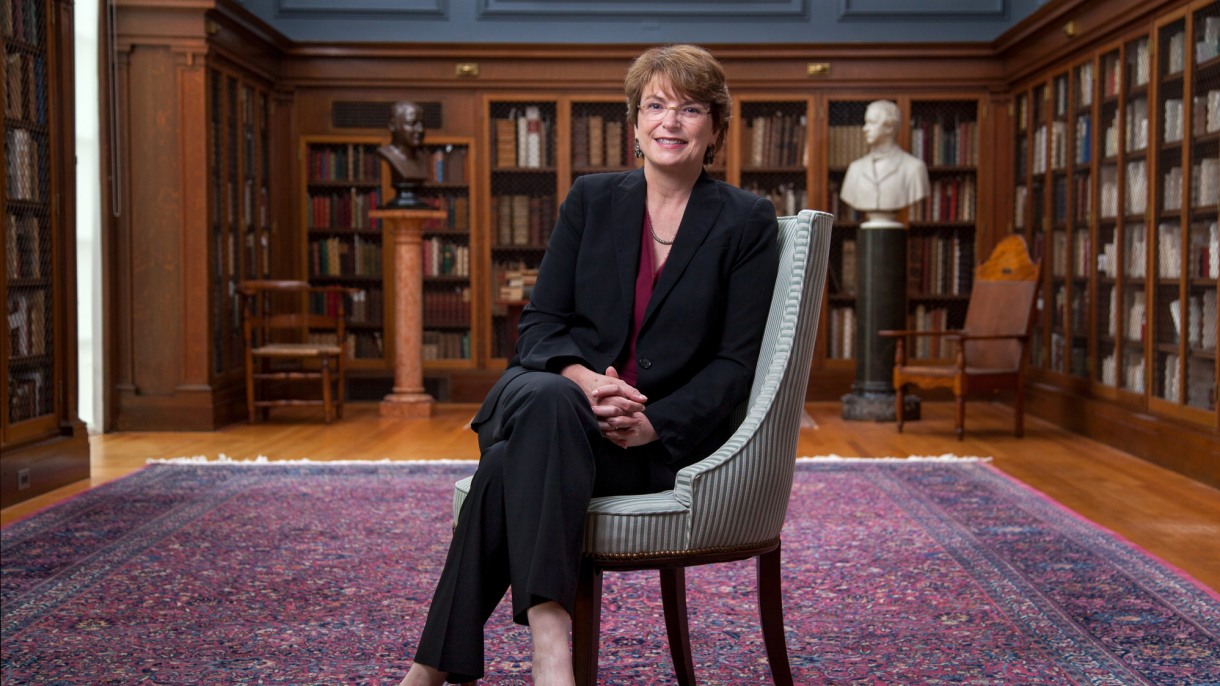
Welcome to Brown University

Welcome to Brown. As a new president joining the University on the eve of its 250th anniversary, I have been “discovering Brown” much in the same way that others do: By exploring the website, walking the campus, and talking to the remarkable men and women who make up Brown’s community.

I’ve learned that Brown is truly a special place. The nation’s seventh-oldest university, Brown cultivates a spirit of free inquiry with a focus on developing the full intellectual, creative and social potential of its members. With 6,100 undergraduates , 2,000 graduate students and 400 medical students, Brown is small enough to provide a strong sense of community in its historic Providence, Rhode Island, location, and large enough to achieve the excellence in education and research to which it aspires. With students and faculty drawn from more than 90 nations and across the United States, Brown prizes the intellectual exchange that is sparked by a diversity of views and experiences.

Brown’s distinctive approach to education sets it apart from other major research universities. The Brown curriculum invites students to be active partners in planning their course of study. The belief that students should be the architects of their own intellectual development extends to both undergraduate and graduate programs. For example, Brown’s new Open Graduate Program enables selected doctoral students to pursue a Master’s degree in a secondary field. Our Program in Liberal Medical Education allows students to combine a four-year liberal arts degree with a Brown medical degree.

Brown’s emphasis on free inquiry attracts students and faculty who value creativity and innovation. Explore Brown, and you will see evidence of this at every turn:

  • A robust arts and humanities environment for creative writing, visual arts, theater, dance, playwriting, music, and digital creations, with year-round exhibitions and performances;
  • Planetary geologists whose instruments have helped NASA explore the planets, moons, and asteroids of our solar system, whose classrooms have received streams of new data and images as they arrived on earth;
  • Brain researchers who are combining insights from neuroscience and engineering to make it possible for people who have lost the use of their limbs to control robotic devices through their thoughts alone;
  • Interdisciplinary teams of scholars who are tackling the world’s most pressing challenges, from climate change, to cyber terrorism, to global inequality, and who actively engage students in this work.

These are but a few examples of the extraordinary work that takes place every day at Brown University. I encourage you to explore our on-line offerings. Even more, I hope you will visit campus to see first-hand the fascinating and remarkable place that is Brown.

Christina H. Paxson
Nineteenth President